
Introduction
Singapore’s insurance industry is entering a new talent phase. As AI, digitalisation and changing customer expectations reshape insurance roles, companies need employees who can do more than understand products and processes. Financial advisers, sales teams, customer service professionals and other insurance employees increasingly need strong digital skills, data awareness and the ability to have confident, customer-focused conversations. For insurance leaders, this raises an important question: Is hiring alone enough to build the workforce your organisation will need next?
The answer increasingly points towards developing the talent you already have. Insurers such as AIA Singapore, Great Eastern, Income Insurance, Prudential Singapore and Manulife Singapore are operating in a market where upskilling and reskilling are becoming important parts of workforce planning. AI can support this shift by helping L&D and business leaders assess capabilities, give employees realistic practice, provide feedback and measure progress. The focus is moving from simply filling vacancies to building a future-ready insurance workforce that can adapt as the industry changes.
Why Is Singapore Facing an Insurance Talent Shortage?
The challenge goes deeper than simply having fewer candidates available. Singapore’s insurance sector is competing with other industries for professionals with specialised capabilities in areas such as data, technology, actuarial science and digital transformation. At the same time, an ageing workforce and the changing nature of financial-services jobs are creating additional pressure on organisations to plan for future talent needs. For insurance leaders, this means that traditional recruitment strategies may not be enough. Building internal career pathways, identifying employees with transferable skills and giving them opportunities to move into emerging roles can become an important part of closing the talent gap.
What Skills Are Insurers Struggling to Develop?
The skills gap in Singapore’s insurance sector goes beyond product knowledge and technical expertise. Employees need to be comfortable using digital tools, understand customer needs, communicate complex insurance products in a simple way and use data to support better decisions. For financial advisers and sales teams, consultative selling and handling customer objections are especially important, while other roles may require stronger problem-solving and technology adoption skills. The challenge for L&D teams is to develop these practical capabilities alongside the product, compliance and process training employees already receive.
Why Do Insurance Employees Need More Than Classroom Training?
- Knowledge does not always become behaviour — Employees may understand an insurance product during training but still find it difficult to explain it confidently in a real customer conversation.
- Practice opportunities are limited — Employees need a safe environment where they can practise difficult questions, objections and customer scenarios before handling them in the field.
- Personalised coaching is difficult to scale — Trainers and managers have limited time, making it challenging to provide regular one-to-one coaching across a large workforce.
- Training completion does not equal readiness — Completing a course can show that an employee has finished the learning, but it does not necessarily show whether they can apply that knowledge effectively.
How Can Awarathon Help Singapore Insurers Close the Skills Gap?
Awarathon is an AI-powered sales training and coaching platform trusted by leading insurance brands including Tata AIA, SBI Life, and Aditya Birla Capital. It helps transform agents into confident, field-ready professionals through AI-powered simulations, instant feedback, and personalised coaching with Trinity, its built-in AI coach. By bringing these capabilities together in one platform, Awarathon enables agents to practise real conversations, strengthen their skills, and continuously improve. It supports organisations across 22+ languages and 15+ countries.
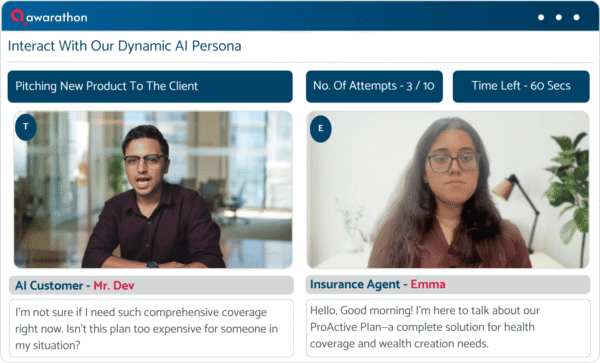
For Singapore’s insurance organisations, closing the skills gap requires more than one-time training. The bigger opportunity is to create a continuous learning journey where employees can identify gaps, build knowledge, practise real customer situations, receive coaching, and track their improvement. Awarathon brings these capabilities together in one platform, helping Singapore insurers create a more connected and effective approach to employee development.
1. Identify Insurance Skills Gaps
Before creating training, insurers need to know where their employees are struggling. Skill Audit assesses how employees demonstrate their product knowledge and communication skills. It helps L&D teams identify specific gaps and understand which areas require additional training or practice.
2. Build Training in One Structured Journey
Insurance training often includes product knowledge, onboarding, sales skills, assessments and other learning activities. Course Builder allows L&D teams to bring these elements together and create a structured learning journey. Employees can progress through the right content, activities and assessments instead of accessing training in separate places.
3. Let Employees Practise With an AI Coach
Employees don’t always have access to a trainer or manager whenever they want to practise. Trinity AI Coach provides an AI-based environment where employees can practise conversations and receive personalised feedback on their performance. For insurance teams, this can help employees improve how they explain products, respond to customers and handle sales conversations.
4. Practise Real Customer Situations With AI
Knowing an insurance product is different from knowing how to handle a real customer conversation. AI Simulations recreate customer interactions where employees can practise answering questions, handling objections and discussing products. Employees can make mistakes, receive feedback and try again in a safe environment before dealing with real customers.
5. Practise and Automate Conversations Through Voice
Many insurance interactions happen over the phone, where employees need to respond quickly and communicate clearly. Trinity Voice enables real-time, human-like voice conversations using AI. Insurance organisations can use it for scenarios such as customer support, appointment scheduling, lead qualification and follow-ups, while employees can practise handling conversations in a more natural way.
6. Manage Every Training Session in One Place
Running training sessions across different teams can involve scheduling, attendance and tracking activities separately. Awarathon’s Classrooms brings these activities together in one place, allowing trainers and L&D teams to create classroom or virtual training sessions, manage learner attendance and keep track of training-related activities. This gives insurance organisations a more organised way to manage instructor-led training at scale.
7. Make Training Accessible Across 22+ Languages
Insurance teams may work with employees from different language backgrounds, making accessible training important for consistent learning. Awarathon supports 22+ languages, allowing organisations to deliver learning experiences that are easier for diverse teams to understand and apply. This can be particularly useful for organisations operating across markets such as Singapore and other countries, where multilingual teams are common.
For Singapore insurance companies, this can help connect workforce development with the skills that employees actually need in their roles.
Helping Leading Organisations Build Future-Ready Teams 
Case Study: How a Leading Insurance Organisation Transformed Sales Training with Awarathon’s AI Coaching Platform
A leading insurance organisation with a large salesforce leveraged Awarathon’s AI platform to strengthen its sales training across regions. Through multilingual AI-enabled video roleplays and interactive simulations, agents were able to practise real customer conversations, improve product knowledge, and strengthen communication and objection-handling skills. Managers gained greater visibility into performance, competency levels, and learning progress through advanced dashboards, enabling targeted coaching and faster identification of skill gaps.
The Measurable Impact of Awarathon
- 2x improvement in product knowledge across insurance agents
- 96% adoption of multilingual training across 17 regions
- 25–30% reduction in onboarding and ramp-up time for new agents
- Increased confidence during customer conversations and field sales interactions
These outcomes highlight the impact of AI-powered coaching on insurance sales performance and workforce development.
Click here to read the full case study. Read the full insurance case study
Looking for an AI-Powered Insurance Training Platform in Singapore?
Help your insurance teams learn, practise, assess, and improve with AI-powered simulations, skill assessments, and personalised coaching.
- Fill the Demo Form – Share your team’s training requirements.
- Explore Awarathon – See AI-powered simulations and coaching in action.
- Train Your Team – Prepare employees for realistic customer conversations.
- Track Progress – Identify skill gaps and monitor improvement.
- Try It Free for 15 Days – Experience Awarathon with your team.
Start your free 15-day trial and discover a smarter way to build insurance sales readiness in Singapore. [Book Your Free Demo]
How Can Insurance Leaders Successfully Implement AI-Powered Training?
Adding AI to a training programme does not automatically solve a talent problem. The technology needs to be connected to the skills employees actually need in their roles.
- Start with the right roles — Focus on teams where better skills can have a clear impact on customer experience, sales, productivity or operations.
- Identify real skill gaps — Understand what employees already know and where they need more support before designing new training.
- Use real insurance situations — Build training around customer questions, objections, product discussions and conversations employees face in their day-to-day roles.
- Make practice part of learning — Give employees opportunities to practise, receive feedback and try again before handling similar situations with real customers.
- Track improvement over time — Use performance insights to see whether employees are actually improving, rather than measuring training only through completion or attendance.
For Singapore’s L&D and HR leaders, this shifts the focus from simply finding talent to building stronger talent from within.
Conclusion
The insurance talent shortage in Singapore is not only a hiring challenge. It is also about helping existing employees develop the skills needed to perform confidently as customer expectations, technology and insurance roles continue to change. Awarathon helps insurers address this by making learning more practical, continuous and connected to real workplace situations. Instead of relying only on traditional training, organisations can give employees more opportunities to practise, improve and apply what they learn. This can help Singapore insurers strengthen their internal talent, improve workforce readiness and build the capabilities they need for long-term growth.
Frequently Asked Questions
1. How can insurers train employees faster with AI?
AI can help insurers scale training across larger teams without relying only on repeated trainer-led sessions. Employees can learn, practise, receive feedback and improve through digital training experiences. This helps L&D teams make training more consistent while giving employees more opportunities to build job-ready skills.
2. How can insurance companies upskill their existing workforce?
Insurers can upskill their existing employees by combining structured learning with regular practice, coaching and assessments. Awarathon helps insurance teams practise product explanations, customer conversations and sales situations, so employees can build confidence and apply what they learn in real workplace situations.
3. Can AI help insurance agents handle customer objections?
Yes. AI can create realistic customer scenarios where insurance agents practise handling common questions, concerns and objections. Agents can try different responses, receive feedback and practise again, helping them become more confident in real customer conversations.
4. How can insurers measure employee training performance?
Insurers can measure training performance by looking at how employees perform, not just whether they complete a course. AI-powered assessments and performance analytics can help L&D teams identify strengths, track improvement and understand where employees may need additional practice or coaching.
5. What features should an insurance AI training platform have?
An insurance AI training platform should offer realistic practice, personalised feedback, assessments, coaching and performance tracking. It should also support relevant insurance scenarios and allow L&D teams to adapt training to different roles, products and customer situations.