Category: Training and Development

  • Introducing Spotlight: An advanced AI sales simulator that helps your sales reps make the perfect pitch

    Introducing Spotlight: An advanced AI sales simulator that helps your sales reps make the perfect pitch

    Introducing Spotlight: An advanced AI sales simulator that helps your sales reps make the perfect pitch 

    It can be challenging for sales reps to anticipate every possible scenario that might arise during customer interactions, especially with the ever-changing market and the abundance of product offerings, it gets difficult to capture the attention of the customer and create a strong impression that ultimately leads to a sale. To help sales reps improve their objection-handling skills, boost their confidence, and prepare them for all sorts of complex customer scenarios, we are announcing an exciting new feature – Spotlight. 

    With Spotlight, sales reps can sharpen their pitch by practicing in a simulated environment that replicates real-life scenarios. 

    It offers a unique approach to training and development, with features like rapid fire questions, unique rep journey, instant reports and advanced AI-simulator to prepare sales reps for all sorts of complex scenarios they might face in customer interactions. Spotlight is the ultimate solution for sales teams who want to stay ahead of the game and maximize their reps’ confidence and pitch. Here are some impressive features that makes Spotlight the go-to solution for maximizing your reps’ sales success: 

    1. Rapid-Fire Questions 

    Help your sales reps think on their feet and handle complex customer objections. By presenting a series of challenging questions in quick succession, this feature encourages reps to think on their feet, develop effective responses, and build their ability to close deals. Ultimately, it’s a valuable tool for sales teams looking to improve their performance and drive revenue growth. 

    1. Gamified Sales Training 

    Who says learning can’t be fun? Spotlight’s gamified approach to sales training makes learning fun and engaging for your sales reps. The interactive format keeps them motivated and fully engaged in the training process. 

    1. Unique Rep Journey 

    Spotlight allows sales reps to prepare for a variety of call scenarios, different industries and Prepares reps for all sorts of scenarios that they might come across during customer interactions. This ensures that they are equipped to handle any type of call that comes their way, providing them with a unique learning experience. 

    1. Instant Reports

    The Instant Reports feature provides real-time feedback to sales reps on their performance, allowing them to review their mistakes and monitor their progress. This instant feedback empowers them to learn and improve quickly and identify areas where they need to focus their efforts. 

    1. Answer-Based Questions 

    This enables your sales reps to comprehend the complexities of every customer interaction. By providing them with a variety of answer options, sales reps can learn to respond appropriately to various objections and improve their communication skills. 

    Key Takeaways 

    Spotlight is an advanced AI sales simulator that equips your reps with the necessary skills and confidence to overcome any obstacle during customer interactions and close deals effectively. Its diverse set of features elevates your reps’ confidence, enhances their objection-handling abilities, and elevates their sales performance to new heights. 

    So, what are you waiting for? 

    Take the first step towards improving your reps’ confidence and objection-handling skills, and see the positive impact it can have on your sales. Try out Spotlight today and watch your sales soar! Book your free trial now 

  • How to empower your sales representatives with strong negotiation skills

    How to empower your sales representatives with strong negotiation skills

    Introduction 

    Gone are the days when sales negotiations were simply about price and product. In today’s rapidly changing market, consumer behavior has shifted dramatically, with buyers having access to more information than ever before about competitors, offerings, and technical details. 

    To be successful in sales negotiations, it is crucial for sales representatives to stay ahead of the curve and develop a deep understanding of consumer behavior. 

    In this blog, we will share insights on developing critical sales negotiation skills in your sales reps’ based on our recent podcast with Dr. Jagmohan Singh Rishi – Vice President and Global Head – L&D coaching and digital consumer experiences at Wockhardt shares his insights 

    Why is developing critical sales negotiation skills important for your sales teams? 

    In today’s world of easy access to information through the internet and smartphones, buyers are more informed and knowledgeable than ever before. As a result, it has become essential for sales reps to have top-notch sales negotiation skills. One of the key benefits of mastering 

    this skill is the ability to create mutually beneficial outcomes for both the sales rep and the customer. 

    Furthermore, sales negotiation skills can also help sales reps simplify complex customer problems, especially in high-stakes sales deals. When faced with challenging conversations, having strong negotiation skills allows sales reps to remain professional and focused on the goal, rather than becoming personally invested in the outcome. 

    Tips for developing critical sales negotiation skills in your reps’ 

    Below are some tips that can help sales reps develop critical sales negotiation skills. 

    1. Identify the customer’s problem 

    To be successful in sales negotiation, it’s important to first focus on identifying customer problems . By identifying the problem and showing how your product addresses and solves them , you are emphasizing its benefits and advantages. This approach not only demonstrates the value of your offering, but also reduces the chance of skepticism from the buyer’s perspective, increasing the chances of a successful conversion.

    1. Win-Win mentality 

    While communicating with potential customers, it’s essential for sales reps to avoid a confrontational, “I win, you lose” mentality. When conversations become challenging or difficult, this can easily lead to a toxic, combative attitude and a “Zero Sum game” mentality. To ensure that conversations remain productive, it’s important to adopt a collaborative approach that prioritizes a “win-win” scenario for both the sales person and the customer. 

    1. Always keep the outcome in mind. 

    It is easy to forget the goal during challenging sales negotiations. The outcome is crucial and it’s important to avoid becoming emotional and taking things personally. Taking negotiations to heart, using defense mechanisms such as stonewalling, sarcasm, shouting, or becoming personally offended, can cause us to lose sight of the goal and negatively impact the outcome. 

    1. Never oversimplify product’s complexities 

    It’s essential to approach the situation in a way that does not diminish the value of the product. Instead of oversimplifying, the sales reps should try to understand the buyer’s perspective and provide additional information or resources that can help them better understand the product’s complexities. This approach can foster a sense of mutual respect and build trust, leading to a more productive sales negotiation outcome. 

    Key Takeaways 

    Successful sales negotiations in today’s market require a deep understanding of consumer behavior, as buyers have access to more information than ever before about competitors, offerings, and technical details. 

    To be successful, sales reps must have strong sales negotiation skills and be able to effectively identify the customer’s needs, adopt a win-win mentality, maintain a clear understanding of the desired outcome, and present a comprehensive understanding of the product being sold. By doing so, they can emphasize the product’s benefits, establish trust with the customer, and work towards a mutually beneficial outcome. 

    Book a demo now to witness the power of Awarathon’s video-roleplay feature in creating successful sales negotiations and pitches.

  • How microlearning can enhance your sales performance

    How microlearning can enhance your sales performance

    Introduction 

    Sales representatives are always on the go, rushing from one moment to another and most often short on time, while shuffling between prospecting and closing deals, liaising with the management and following-up with the customers. In the midst of a never ending list of to dos, their learning and development needs often take a back seat, which may ultimately contribute to poor job satisfaction. 

    With today’s rapidly evolving and highly-competitive markets, the need for continuous training and development of the sales representatives cannot be overstated. Keeping up with market changes is critical for an organization and training of sales representatives is a crucial part of market readiness. However, the current training methods, which involve bombarding sales representatives with large volumes of information, are proving to be ineffective. One of the methods that organizations can adopt for effective training and development of sales representatives is ‘Microlearning’. 

    What is Microlearning? And how can it be delivered? 

    The concept of microlearning can be traced to Ebbinghaus’ Forgetting Curve. Hermann Ebbinghaus (1850-1909) was a German psychologist who founded the experimental psychology of memory. The forgetting curve is a mathematical formula that describes the rate at which information is forgotten after it is learned. The theory seems to suggest that we tend to forget new information that we learn within a few days, unless we make specific efforts to review and retain the information. Training methods must therefore be a combination of (i) imparting information; and (ii) reinforcement of information. 

    Microlearning involves learning through short and repetitive bursts of information until knowledge is fully embedded in long-term memory. From a training perspective, microlearning can be adopted by designing short training courses that are fun, engaging and concise. The infographic below demonstrates how training courses can be designed for microlearning. 

    How to use microlearning for sales training? 

    Sales training requires ongoing training but many sales reps do not have time to go through traditional training as they are always expected to be on the move. For example, they are working in the fields, traveling to meet clients and customers. Micro-learning is a smart strategy to train sales reps as they are bite-sized learning segments that don’t take more than ten minutes. Moreover, sales reps can access them anywhere and whenever they want 

    Here are 4 learning strategies you must use in your microlearning sales training program to get the best results. 

    1. Interactive Infographics – Our brains process images and videos much faster than text. Infographics can be used for sales onboarding or change management.
    2. Simulations – Simulations based on real-life client scenarios can help sales reps be better prepared in handling complex interactions. This will also improve their selling and decision-making skills 
    3. Micro-assessments – Knowledge checks like quizzes and tests, auditing phone recordings, and reviewing email pitches can help absorb the training content effectively. Animated Videos – Presenting large amounts of information through animated videos can be very effective, especially while learning about company products and services. This is very useful for sales onboarding 

    Conclusion 

    Adopting effective learning and development programs help organizations attract and retain talent as opportunities to continuously learn, develop and grow contribute significantly to overall job satisfaction of sales representatives. The training and development teams of organizations must ensure that the training programs do not overwhelm the sales representatives and become one of the mandatory to-do things that do not pique their interest. Micro-learning is a perfect strategy that can be utilized to train and engage employees whenever and wherever they want. 

    Want to see how Awarathon works, click here to book a demo now

  • 5 tips on driving behavioral change in the sales teams

    5 tips on driving behavioral change in the sales teams

    Introduction 

    Driving behavioral change in training sales team reps is key to increasing sales opportunities and creating a culture of unity and knowledge sharing. But we know that it is not easy to change ingrained habits and behaviors, however, it is not impossible! 

    With the current era of the dynamic business environment and evolving consumer behaviors, it is inordinately important for organizations to be behavior-centric rather than results-centric. To understand how organizations can drive behavioral change in the sales teams, we spoke with Mr. Prabhat Pandey in the recent episode of our podcast series – Pitch Perfect. 

    We need to look deeper into behavioral economics. And, behavioral economics states that human behavior is mostly sourced from three areas. One is desire, another one is emotion and the third one is knowledge, says Prabhat. In this post, we will share 5 tips so that you can propel behavioral change in your organization. 

    1. Make sure reps are aligned with the organization’s culture 

    ‘To propel behavioral change, everything starts with the organization’s culture, says Prabhat.’ The sales leadership has to make sure that sales reps understand the culture and that their behavior aligns with the culture. 

    In order for reps’ to learn the culture of an organization, the leadership has to empower them with the right tools, support, and coaching. When employees’ values and behaviors are aligned with the culture, there is less uncertainty in what is expected of them. 

    1. Help your sales reps understand their customers 

    Most organizations still rely on sales reps’ relationships with the customers. They segment consumers based on behaviors and make sure that the reps’ are making the right pitch aligned to the social style of the consumer. 

    “It is important to dig a little deeper to understand the consumer better, states Prabhat.” Organizations can also utilize the science of behavioral economics in their strategies to drive sales conversions. By understanding consumers, sales reps’ can also help consumers make an informed decision. 

    1. Treat training as a journey, not an event

    A lot of organizations consider behavioral training as a one-off affair that can fix all the issues. But it is important to know that there is a forgetting curve when it comes to training.If training is not revisited or reinforced, most learning tends to evaporate. 

    To drive behavioral change, the management needs to look at training as a long-term process. The line managers need to make sure that sales reps’ apply these behaviors in their work followed by behavioral training. 

    1. Encourage positive behaviors like sincerity and genuineness 

    Firstly, sales reps should focus on solution orientation, empathy and being genuine and truthful with the customers. In this generation, it is important that customers don’t feel like you are the sales guy and rather, have to help the customer make an informed buying decision. 

    1. Make training engaging 

    If the entire team is disengaged, it is important for the trainer to go back to the training board and reassess the training needs analysis. But if few sales reps are disengaged, it helps to take feedback on what is not working and clarify expectations and monitor performance. 

    Bottomline 

    There are a lot of factors that affect a sales rep’s behavior at the workplace. It could be the work culture, personal life, job satisfaction, and upbringing. Organizations cannot influence these factors but, they can drive desired behavior in reps by diligently following the above strategies. Enhancing the sales employee behavior is key to a productive work environment. 

    Technologies like AI are driving behavior change in sales reps through data-driven personalized training. In conclusion, Awarathon is a sales coaching platform that leverages AI to enable personalized training that boosts employee productivity and engagement. 

    If you’re ready to boost employee productivity and engagement. Check out Awarathon’s AI-enabled sales readiness platform.

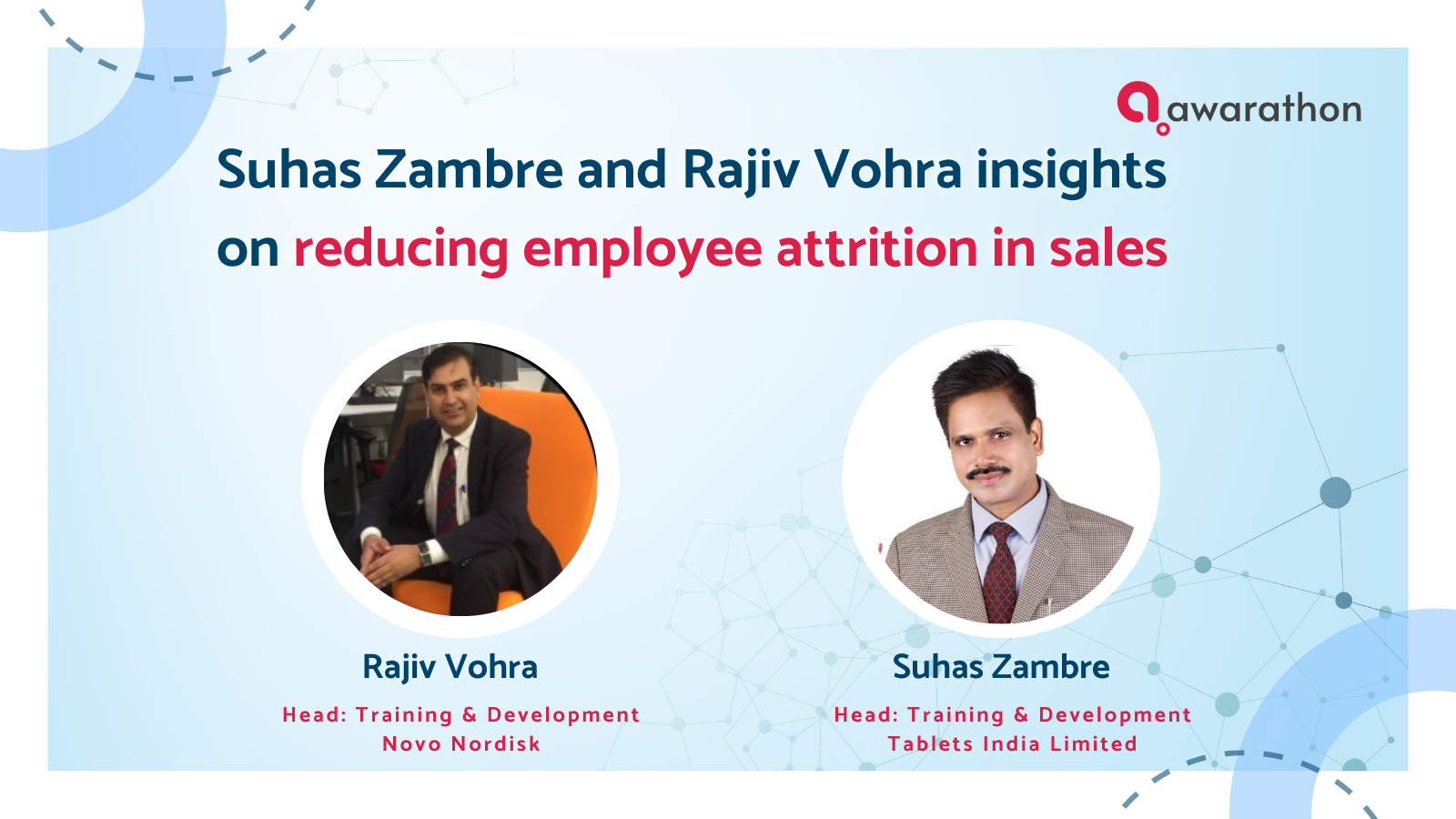
  • Suhas Zambre and Rajiv Vohra share their 7 tips on reducing sales employee turnover

    Suhas Zambre and Rajiv Vohra share their 7 tips on reducing sales employee turnover

    Introduction 

    High sales employee turnover negatively affects an organization’s profitability in various ways. It reduces sales opportunities, increases additional expenses on hiring new employees, and reduces employee productivity. Therefore, it is in a company’s best interest to reduce employee attrition. 

    To understand why there is high employee attrition in some sales organizations, we teamed up with Suhas Zambre (Head of training and development at Tablets India) and Rajiv Vohra ( Head of training and development at Novo Nordisk). 

    Training is very liberal, but what I’ve seen is that we go into the training with business requirements but, the actual training is much more of an in-depth understanding. Suhas Zambre and Rajiv Vohra were featured in our panel series – Pitch Perfect and shared their tips on reducing employee attrition in sales. 

    1. Careful hiring process 

    One of the ways to reduce sales employee turnover is to select the right candidates. It is important that recruiters are upfront about the job role and company culture and ensure that a candidate is the right fit. Moreover, it is important to have a robust onboarding structure. This helps in setting up the employees for success from the beginning. 

    1. Employee engagement 

    Engaging sales employees can definitely help in reducing sales employee turnover. One of the best ways is through recognition as words are very important in cultivating employee motivation. Having a good relationship with managers is very essential for increasing employee engagement. 

    1. Coaching conversation culture 

    Cultivating a coaching conversation culture as part of your talent management strategy can be very effective in reducing sales employee turnover. It creates an environment of high performance and self-development. 

    1. Competitive employee compensation 

    Low compensation demotivates employees. Organizations must take care of this by offering competitive salaries to attract competent employees and regularly offering incentives and raises. 

    1. Involvement of Top Management 

    The top management needs to get involved in setting up the learning structure. The managers have to be involved in the whole learning journey of their employees. Otherwise, the employees would not be able to pick up the learning, and the entire training is futile. 

    1. Scientific Training 

    Training the sales employees has to be scientific. Organizations have to use well-established models and look at the impact of the training. They need to focus on quantitative measures to move away from only qualitative measures. 

    1. Capability Building 

    Capability building is one of the reasons behind the sales employee turnover. People leave when they are not seeing a future in the organization. Companies have to cultivate a workplace that felicitates employee growth.

  • Harsh Monga’s 7 tips on disrupting the sales training landscape

    Harsh Monga’s 7 tips on disrupting the sales training landscape

    Introduction 

    Sales training is all about improving the seller’s overall sales readiness to drive seller behavioral change and maximize sales success. To understand the sales training landscape, we teamed up with Harsh Monga, a dynamic leadership and executive coach and the director and head of sales training at Dr. Reddy’s. 

    Not everyone learns the same way, though they might be learning the same thing. I think most of the people who might be reading this, if they are in the training industry, would understand that different people have different learning styles.

    Harsh Monga was featured in our podcast series – #Pitch Perfect and shared his tips on designing the perfect sales training program. 

    1. Outcomes and not outputs 

    ‘Activity is not productivity’, says Harsh Monga. Sales training is not about how much effort we are putting in terms of training people, it is about how much impact we can create on team performance and the business. 

    It is important to sit with all the stakeholders and decide on the training outcomes before rolling out the training program. This helps in understanding the effectiveness of training. 

    1. 3E’s for Effective Training 

    When it comes to learning, three things are very important – Education, Experience, and Exposure. Education comes from the formal sales training that we provide to sales reps. Exposure comes from interacting with other people, learning from peers, on-the-job coaching, and the guidance of their managers. Experience is working on the job, experiencing different scenarios with customers, and going through different projects and assignments. 

    The rule is that people learn more from 70% of experience, a little less than 20% from exposure, and just about 10% from formal education. But all three are important in designing an optimal sales training program. 

    1. Focus on creating robust Training Needs Identification 

    To create a unique and personalized learning experience, it is important to make sure that training needs identification is a robust one. Baselining through competency assessments is very important to identify who needs what kind of inputs, and create cohorts of people with similar training needs. 

    1. Measuring sales training program 

    The effectiveness of sales training can be measured based on a lot of matrices. It is not always sales or revenue numbers. It can be based on employee attrition, productivity measures, CSAT, and net promoter scores. Therefore, the effectiveness of a sales training program needs to be decided and agreed upon while designing the sales training program. 

    1. Artificial Intelligence use in sales 

    Even though there will be a shift in terms of AI-enabled sales coaching, it will never completely replace the manager’s guidance and intervention. And, it will never replace the human part of sales coaching. Therefore, utilize AI in assisting managers and critical aspects of sales training. 

    1. Game-based learning is Overrated 

    There was a lot of hype on game-based learning, and organizations built such games where employees could learn, but it takes too much effort, money, time, and resources to pick up knowledge from these games, and the ROI is not very significant. 

    Now, people have switched from game-based learning to leaderboards, and that has been working quite well for sales training. Leaderboards can be used to assess the sales reps’ performance and also, reward the reps with exciting prizes and points. Hence, improving their sales performance 

    1. Video-based learning is still underrated 

    According to Harsh Monga, video-based learning is still very underrated. He believes it is one of the best ways of training sales teams. For most people watching videos is the fastest way to learn and retain information but the videos have to be engaging and interactive. 

  • Prachi Mishra’s 5 tips to build high-performing sales teams

    Prachi Mishra’s 5 tips to build high-performing sales teams

    The success of a sales organization greatly depends on having a successful sales team. However, building a successful sales team can be challenging. High-performing sales teams have characteristics that stand out beyond their performance. To understand why some sales teams underperform, we teamed up with Prachi Mishra, a dedicated leader across learning & development, executive coaching, and organizational development, and the regional Head of Learning- APAC Global Learning & Leadership at Vanderlande. 

    “One of the things that stands out most for high-performing sales teams is a culture of engagement,” she says. “So look around, and you will see teams that are performing at their best, they have employees who are highly motivated and engaged”

    Recently, Prachi Mishra was featured in our podcast series – #Pitch Perfect and shared her tips on building high-performing sales teams. 

    1. Listen with Empathy 

    The first thing that organizations must do to build high-performing sales teams is to listen to every individual in their sales teams with empathy and make sure their voices are heard. Moreover, you have to listen with a mindset of curiosity and understanding, not provide solutions. 

    1. Create Diversity 

    Most high-performing sales teams are usually diverse and unique. This means every sales rep is different from another. They are complementary to each other in terms of talent, skills, experiences, and expertise. Therefore, sales leaders must ensure that they bring in enough diversity within their teams. 

    1. Build a culture of engagement 

    One of the hallmarks of a high-performing sales team is a culture of engagement. Sales leaders today have to make sure that their teams engage, maximize each team member’s performance, and motivate them every day. 

    1. Clarity of goals 

    When it comes to high-performing sales teams, each member is absolutely clear in terms of what their goal is, what the team’s goal is, and what their individual goal over the individual contribution is to the team so that they can collectively achieve their goals. 

    1. Foster Leadership 

    In high-performing sales teams, managers are leaders who are not just bothered by KPIs but go beyond the call of duty. These are managers or leaders who become coaches. So when it comes to sales, they know what they’re selling, how they are selling, and they’re very proficient in the business of selling, but they are equally proficient in the space of coaching. Moreover, they can assess skill gaps in their team members, develop a coaching plan, provide timely feedback, mentor their team members, give the right support, empower their teams, and they do all of this in a very structured approach. They continuously make sure that the big picture is known to their team members, and they make sure that they create a space where team members can flourish. 

    With Awarathon as your sales coaching platform, managers get actionable insights and roadmaps to optimize their sales coaching efforts.

  • 5 point checklist for choosing the right sales readiness platform

    5 point checklist for choosing the right sales readiness platform

    Introduction 

    In the present times, the notion of a sales organization has undergone significant changes. One such big shift is the ever-changing buyer expectations. To engage and keep up with the buyer’s demands, it is not enough for the sales representatives to just have the right skills. They must also have the ability to engage the buyers throughout their journeys and form meaningful connections. To keep up with these changes, organizations are looking beyond their traditional sales training programs toward sales-readiness platforms powered by technology. 

    Sales readiness platforms equip the reps with the information and resources needed to be effective communicators, thereby improving their productivity. In this post, we will reveal a pivotal checklist that will help your organization choose the right sales readiness platform. 

    1. A sales readiness platform that delivers measurable outcomes 

    An effective sales readiness platform must provide measurable insights on customer experience, key performance indicators, and competency gaps of reps and provide an actionable roadmap to make your sales reps sales-ready. It is also crucial to present the insights in a way that is easy for the target users to understand. 

    You need to choose a platform that assesses all the verbal and non-verbal behaviors of reps and takes your customers and businesses’ unique needs into consideration. 

    1. A sales readiness platform that provides customization and support.

    You don’t want a sales readiness platform that provides generalized sales guidance and does not take your unique business needs into consideration. An effective sales readiness platform takes your specific business needs and target audience into account and tailors its guidance to sales reps so that they can have high-value conversations with actual customers. 

    1. A sales readiness platform that enhances reps’ knowledge and skill

    One of the main motivations for using a sales readiness platform is to have your sales reps ready with proper behavior skills and relevant knowledge, helping them to effectively communicate with their target customers and improve sales productivity. Therefore, readiness platforms have a vast library of learning material to instill the right behavior and knowledge. Sales readiness platforms enabled by AI can identify the competency gaps of reps and provide an actionable roadmap to upskill and enhance reps’ knowledge. 

    1. A sales readiness platform that can implement peer-to-peer learning.

    Many sales readiness platforms ignore this aspect and don’t leverage the knowledge and data on high-performing sales reps to help low-performing reps. You need to look for a platform that analyses and provides insights on the techniques and strategies of high-performing reps. With the help of AI, your high-performing reps can become benchmarks for success that can help other sales reps in developing these skills and knowledge. 

    1. A sales readiness platform that can update your training program as and when your business needs change 

    Your organization may decide to launch a new product or may pivot to target a new audience or a new market. Business needs inevitably evolve, and so do the needs of your sales team. Choose a platform that can customize and adapt to the changing needs of your business. 

    Bottom-line 

    Choosing a sales readiness platform for your organization should be a well-thought-out decision. The right platform can set up your organization for a greater magnitude of sales success. Reflect on these five points to ensure that your sales team has all the right tools and applications that can assist them in becoming effective communicators. 

    About Awarathon 

    A sales readiness platform that provides a virtual practice environment allowing reps to practice their pitch deeply assesses competency gaps in reps, and provides actionable insights and roadmaps, maximizing support to your sales team. Awarathon provides customizable guidance and adapts its training platform to your business needs. Therefore, ensuring a smooth sales readiness experience. 

    To learn more about Awarathon, contact us or schedule a demo to discover how Awarathon can design a unique sales readiness experience for your organization.

  • Sales coaching at scale while approaching individual needs of sales reps

    Sales coaching at scale while approaching individual needs of sales reps

    The capability to adapt to things is what takes learning to the next level

    Generally, all sales executives go through the same sales coaching/ sales training program regardless of their skills, knowledge, and working experience. The recent hires and senior team members are at various competency levels. But, yet they are trained identically in the same manner. The difficulty with a one-size-fits-all approach is that not all get what they require, and overall program effectiveness is limited. It might be better for some but not the entire sales team as everyone has a different background and experience. Moreover, training needs to be a lot more interactive and engaging with real-life case studies and objection-handling scenarios to add impact and all-round development. 

    Some of the core aspects of a sales training program must include: 

    • Product Knowledge 
    • Market Understanding 
    • Buyer Behaviour 
    • Competitor offerings 
    • Challenges/problem-solving 
    • Skill + learning gap analysis 
    • Practical insights and demos 
    • Peer-peer interactive sessions 

    In a way to ensure that your sales team is trained holistically. 

    An example for reference: 

    Either there is a new product launch or an extension to an older one. The sales team needs to understand the marketing communication, product messaging, buyer personas, product knowledge, competition understanding, market trends, industry growth, and several other parameters. 

    Sales is just not just about selling. 

    It is a process of building real relationships with your audience, through the right marketing channels and communication mediums to solve their business problems with your offerings (solutions). 

    The method to approach | Sales Training Program: 

    In a sales training program, the learning experience matters.

    A fresher sales representative with 0-3 years of experience may require something else and an experienced sales manager with 6-8 years of experience will demand a different approach to learn. Their learning approach, grasping abilities, execution patterns, and strategizing things are different. 

    Experienced sales reps can see the importance of preparation due to their experience. They may need it the most. New representatives tend to be fresh look at everything with optimism and value any available resources. They take the practice with more effort and are eager to apply it. Those more senior can struggle as they are set in their ways, almost pre wired to deliver a specific message. It’s essential to understand this difference and provide a learning experience that fits each person where they are & what they want to achieve. The objectives of a sales executive will not be the same as that of a senior sales manager. 

    The working approach | Sales Training Program: 

    A way that adapts an individual’s training experience based on skill level and execution is the answer. 

    Each learner is directed to resources, and support based on their requirements and performance. The result? Adaptive Learning allows you to scale coaching across competency levels while discussing the needs of each individual. 

    Hence, one-size-fits-all programs or coaching solutions are not the answer for an organization that wants to scale up its sales performance. It is because the sales reps working in your organization are of different levels. So, the challenges they face are not the same & understanding them and providing a unique set of solutions to each of them is the answer. 

    Sales training program | Way forward: 

    The next step could be to perform assessments in the form of a quiz, MCQ, for your sales team to identify knowledge gaps and know how well they perform objection handling, which is easily possible through a video roleplay platform. Therefore opting for a robust video roleplay platform to identify how well your sales reps can perform through the training and the coaching they did is essential. 

    Why opt for a Video Roleplay Platform? 

    Performance begins with practice and learning.

    A video roleplay platform offers some of the essential features required for your organization. To scale up your sales process online and meet your sales quotas with ease. A sales readiness platform or a video roleplay platform in simple terms acts as a post-sales coaching tool. 

    It covers all the various stages of the sales cycle before the sales reps interact with their respective buyers. Also, enabling sales managers and business owners to get a detailed performance overview report for their teams, forecast sales better, identify knowledge gaps, and improve learning curves. Therefore, a video roleplay platform has a lot more to offer for organizations looking to transform their sales abilities online and grow more with their sales teams. 

    Conclusion: 

    Even if you as an organization or a start-up have a sales training program. You need a post-sales training/ after-sales coaching platform where your sales reps/ executives can practice their learnings in a detailed and structured manner. 

    Explore more on our Platform.

  • Informal vs. Formal Learning: Things to Know

    Informal vs. Formal Learning: Things to Know

    For a business that often wonders, which is the proper technique to learn formal or informal learning? Let’s first understand the difference between both and how organizations or businesses can benefit from both of them. 

    Formal vs. Informal Learning: Sales Learning Method 

    Formal learning is structured in nature. Most trainers and coaches lead it in a structured way. On the other hand, informal learning has no traditional structure or curriculum, offers more flexibility for learners, and can often be accessed on the go via mobile devices. Thus, it is essential to know the different opinions between these two. At Awarathon, coaching experience can be opted for based on the company’s needs, objectives, and goals. 

    An example in simple terms could be a bus and bike. There is a defined route, fixed stops, and consistent speed related to formal learning ways when you travel by bus. Whereas in the case of informal learning, it is like a person traveling on a bike. He can change the speed as per his time to reach the duration, decide on the breaks, etc. 

    Formal vs. Informal Learning: How to Decide Which Sales Learning Method is Better? 

    Every company’s difficulties are different, and hence their training programs should be too. It comes down to your company’s specific needs and how a formal and informal learning program can best help. For example: 

    • Audience: Is formal training too time-consuming? Is it having a better impact? Do learners follow up when they need info? 
    • Tracking & Reporting: What are you precisely tracking? How many people need to generate reports? 
    • Content Development: Is it complicated to create and deliver content? Are there any troubles generating messaging? 

    By now, you must have known the difference between these two types of learning. So, it is time to initiate building a program for your company. While developing a training strategy for your company, keep in mind – figure out the objectives and goals first. 

    Then approach the program selection to make better sense. Many times a blended learning method of informal and formal coaching is the proper approach to move. You can also learn about How Innovative learning methods to build great Work performance for Sales. 

    How does Sales readiness software relate to this? 

    When you opt for sales readiness software, both formal and informal learning methods are more inclined towards the informal approach. Sales readiness in simple terms – a post-sales training assessment aspect, figure out what have your sales reps learned in the sales coaching program. 

    Its relevant features include peer-to-peer learning, content sharing, and assessments in various formats. Also, to practice sales pitches online, on-the-go connectivity makes it one of the most preferred choices amongst sales leaders and managers for their sales teams.

    To brief you with an example, the sales coaching program can be considered as a formal learning approach, whereas sales readiness software could be an informal one. Hence, more and more organizations opt for a robust sales readiness solution to streamline and monitor their sales process, efforts, and targets online effectively. 

    To explore our portal and know more about us, either email us at info@awarathon.com or fill in the form here – http://awarathon.com/demo/, our team member, will get in touch with you shortly.