Blog

  • 5 tips to leverage AI in sales training: Saumil Paronigar shares his insights

    5 tips to leverage AI in sales training: Saumil Paronigar shares his insights

    Introduction 

    It is undisputed to say that there is immense potential in leveraging artificial intelligence in sales. Leveraging AI in sales training gives sales reps a more realistic experience. It is more accurate and can run without any geographic constraints. 

    When adopted well, AI can be an invaluable tool that can help companies predict the learning gaps in sales reps’ therefore, creating a personalized and individual development plan. 

    To understand how organizations can effectively leverage artificial intelligence in sales training, we spoke with Mr. Saumil Paronigar in our podcast series – Pitch Perfect. Just imagine how many redundant tasks sales reps do daily can be reduced. It will save the team from repeatedly shooting in the dark to get new prospects. Sales reps can focus more on identifying new potential buyers and closing deals.

    Read on below and follow these 5 tips on effectively adopting artificial intelligence in your sales training program. 

    1. Set criteria and standards 

    Organizations need to create a specific set of standards and criteria for each skill model. They need to understand the standard way of doing things at every juncture of the sales cycle in their industry. When adopting AI in sales training, they need to have a team of experts who know both AI technology and sales training. 

    1. Integration of other tools with AI 

    You have to choose a holistic AI program that can smoothly integrate with every other system in the organization. For example, you should be able to integrate your AI tool with the lead management system, customer onboarding tools like CRM, employee onboarding journey and performance management system. 

    1. Feedback from customers 

    It can be advantageous to take feedback from customers on their preferred approach from the sales rep. By collecting all this data, you can make sales training more realistic. You can develop a robust system to implement this feature in your AI tool. Therefore, effectively adopting AI in sales training. 

    1. Understand your employees 

    Organizations must understand their sales fraternity as most of the current employees are gen z with a unique approach toward work. The senior management needs to know the demography and identify if there is any resistance to adopting the AI system. This can be a huge barrier since leveraging AI in sales training is change management for an organization as you will transform how sales reps conduct business. 

    1. Accurate algorithm 

    It is very critical to have the right algorithm whether an organization is engineering its own platform or with an enabled system. Not designing the right algorithm can make sales training more cost-effective and time- critical. 

    Bottomline 

    Artificial intelligence is making big transformations in the field of employee training and sales training. But it is important for organizations to take the above necessary steps to successfully implement it. 

    Get in touch with Awarathon to learn more about preparing your organizations to leverage AI in sales training now.

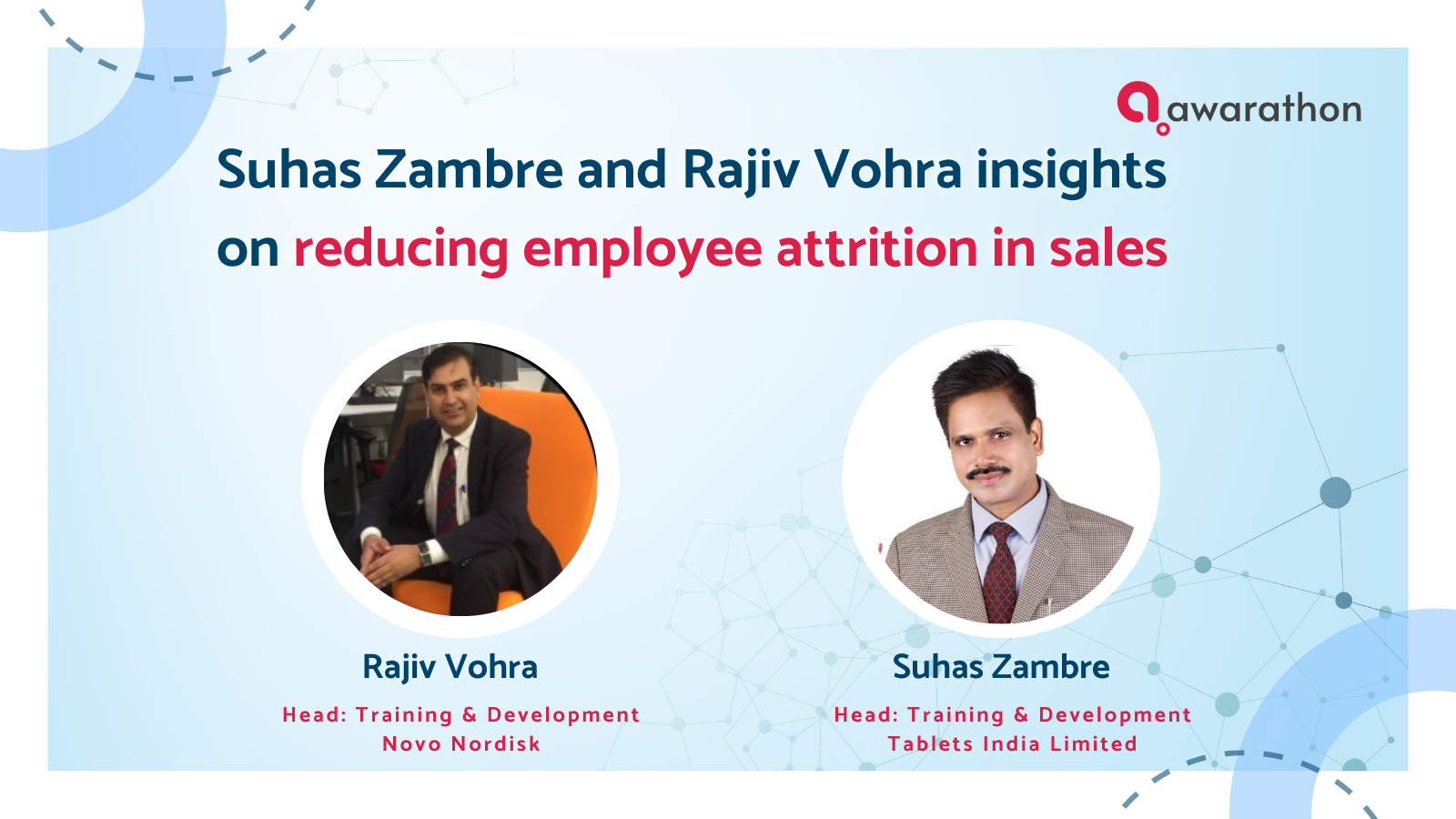
  • Suhas Zambre and Rajiv Vohra share their 7 tips on reducing sales employee turnover

    Suhas Zambre and Rajiv Vohra share their 7 tips on reducing sales employee turnover

    Introduction 

    High sales employee turnover negatively affects an organization’s profitability in various ways. It reduces sales opportunities, increases additional expenses on hiring new employees, and reduces employee productivity. Therefore, it is in a company’s best interest to reduce employee attrition. 

    To understand why there is high employee attrition in some sales organizations, we teamed up with Suhas Zambre (Head of training and development at Tablets India) and Rajiv Vohra ( Head of training and development at Novo Nordisk). 

    Training is very liberal, but what I’ve seen is that we go into the training with business requirements but, the actual training is much more of an in-depth understanding. Suhas Zambre and Rajiv Vohra were featured in our panel series – Pitch Perfect and shared their tips on reducing employee attrition in sales. 

    1. Careful hiring process 

    One of the ways to reduce sales employee turnover is to select the right candidates. It is important that recruiters are upfront about the job role and company culture and ensure that a candidate is the right fit. Moreover, it is important to have a robust onboarding structure. This helps in setting up the employees for success from the beginning. 

    1. Employee engagement 

    Engaging sales employees can definitely help in reducing sales employee turnover. One of the best ways is through recognition as words are very important in cultivating employee motivation. Having a good relationship with managers is very essential for increasing employee engagement. 

    1. Coaching conversation culture 

    Cultivating a coaching conversation culture as part of your talent management strategy can be very effective in reducing sales employee turnover. It creates an environment of high performance and self-development. 

    1. Competitive employee compensation 

    Low compensation demotivates employees. Organizations must take care of this by offering competitive salaries to attract competent employees and regularly offering incentives and raises. 

    1. Involvement of Top Management 

    The top management needs to get involved in setting up the learning structure. The managers have to be involved in the whole learning journey of their employees. Otherwise, the employees would not be able to pick up the learning, and the entire training is futile. 

    1. Scientific Training 

    Training the sales employees has to be scientific. Organizations have to use well-established models and look at the impact of the training. They need to focus on quantitative measures to move away from only qualitative measures. 

    1. Capability Building 

    Capability building is one of the reasons behind the sales employee turnover. People leave when they are not seeing a future in the organization. Companies have to cultivate a workplace that felicitates employee growth.

  • Harsh Monga’s 7 tips on disrupting the sales training landscape

    Harsh Monga’s 7 tips on disrupting the sales training landscape

    Introduction 

    Sales training is all about improving the seller’s overall sales readiness to drive seller behavioral change and maximize sales success. To understand the sales training landscape, we teamed up with Harsh Monga, a dynamic leadership and executive coach and the director and head of sales training at Dr. Reddy’s. 

    Not everyone learns the same way, though they might be learning the same thing. I think most of the people who might be reading this, if they are in the training industry, would understand that different people have different learning styles.

    Harsh Monga was featured in our podcast series – #Pitch Perfect and shared his tips on designing the perfect sales training program. 

    1. Outcomes and not outputs 

    ‘Activity is not productivity’, says Harsh Monga. Sales training is not about how much effort we are putting in terms of training people, it is about how much impact we can create on team performance and the business. 

    It is important to sit with all the stakeholders and decide on the training outcomes before rolling out the training program. This helps in understanding the effectiveness of training. 

    1. 3E’s for Effective Training 

    When it comes to learning, three things are very important – Education, Experience, and Exposure. Education comes from the formal sales training that we provide to sales reps. Exposure comes from interacting with other people, learning from peers, on-the-job coaching, and the guidance of their managers. Experience is working on the job, experiencing different scenarios with customers, and going through different projects and assignments. 

    The rule is that people learn more from 70% of experience, a little less than 20% from exposure, and just about 10% from formal education. But all three are important in designing an optimal sales training program. 

    1. Focus on creating robust Training Needs Identification 

    To create a unique and personalized learning experience, it is important to make sure that training needs identification is a robust one. Baselining through competency assessments is very important to identify who needs what kind of inputs, and create cohorts of people with similar training needs. 

    1. Measuring sales training program 

    The effectiveness of sales training can be measured based on a lot of matrices. It is not always sales or revenue numbers. It can be based on employee attrition, productivity measures, CSAT, and net promoter scores. Therefore, the effectiveness of a sales training program needs to be decided and agreed upon while designing the sales training program. 

    1. Artificial Intelligence use in sales 

    Even though there will be a shift in terms of AI-enabled sales coaching, it will never completely replace the manager’s guidance and intervention. And, it will never replace the human part of sales coaching. Therefore, utilize AI in assisting managers and critical aspects of sales training. 

    1. Game-based learning is Overrated 

    There was a lot of hype on game-based learning, and organizations built such games where employees could learn, but it takes too much effort, money, time, and resources to pick up knowledge from these games, and the ROI is not very significant. 

    Now, people have switched from game-based learning to leaderboards, and that has been working quite well for sales training. Leaderboards can be used to assess the sales reps’ performance and also, reward the reps with exciting prizes and points. Hence, improving their sales performance 

    1. Video-based learning is still underrated 

    According to Harsh Monga, video-based learning is still very underrated. He believes it is one of the best ways of training sales teams. For most people watching videos is the fastest way to learn and retain information but the videos have to be engaging and interactive. 

  • The impact of Artificial Intelligence in driving Sales

    The impact of Artificial Intelligence in driving Sales

    Role of AI in Sales : 

    Nowadays, meeting client requirements and handling objections is not that easy because of the availability of information at your fingertips. To determine what suits the client’s needs and which solutions they require to resolve their business concerns, there is a need to understand your saas product offerings and your buyer persona in detail. Besides sound research, competitor analysis, product offerings, and knowing customer behaviour, there is also a need for the sales teams to polish their soft skills to master the art of virtual selling and that is possible through practice. It is where we assist businesses with sales teams with a “Pitch Perfect. Always.” working approach. Our AI-enabled, video roleplay platform ensures your sales teams hit the right notes. Consistently. 

    Large corporations and multinational companies have huge sales teams. Therefore, making it tedious for sales heads and supervisors to track performance and monitor achieved quotas. As it involves a lot of manual work, increased effort, and consumes a lot of time which can be utilized in other core work aspects like strategy planning or new development plans. In our today’s blog article we will be exploring how artificial intelligence will help sales teams level up their game. Therefore, it is essential to understand the role of AI in sales. 

    Artificial intelligence: 

    Artificial intelligence enables computers to perform tasks that typically require human intelligence. With the help of AI, computers can store and process huge amounts of data, and based on this data computers can generate valuable insights. Hence an AI-backed sales coaching platform is perhaps just what managers need to make their task easy. 

    Let’s have a look at leveraging AI to improve sales coaching.

    Improved Flexibility 

    AI-based training platforms can be access from anywhere at any time. All it needs is an internet connection. Whenever sales representatives get free time they can open the platform and start training. They don’t have to invest their selling hours into training so it becomes very convenient for them. Also, this is beneficial for the organization, as their sales representatives will be putting more time into actually selling the product/service. 

    Voice Analysis 

    AI has a digital converter that converts sound waves into digital data that computers can understand. AI can also identify differences in the pitches and the speed of speaking. Through this AI-based-training platform can record and analyze the conversation and can give feedback on the same. 

    Body language

    With the use of cognitive analysis, AI can process human actions and expressions from the recorded video just like a human brain. AI can analyze the body language and facial expressions of a sales representative and give scores accordingly. 

    Unbiased Feedback 

    With the help of AI, training platforms analyze the performance of different sales representatives and compare it to the standard answer to give scores. The scoring is completely data-driven and unbiased. A human manager may be prone to different kinds of biases while scoring the employees. Because of AI giving pure unbiased feedback has become possible. 

    Enhanced Tracking 

    All the data related to the performance of a particular sales representative or a cluster of sales representatives is shown on a single dashboard. This helps managers to track the progress of sales representatives and check who is performing well and who is underperforming to re-strategize or rework efforts on the team accordingly. 

    How Awarathon’s AI helps your sales team to make effective winning pitches. 

    Awarathon is a dynamic video-roleplay-led sales coaching platform. We create a virtual training environment leveraging AI to help sales representatives in improving their skills and performance. 

    Following are some distinctive features of Awarathon – 

    Frame different types of questions 

    Sales managers while creating assessments can frame questions like situation-based and objection handling which help in assessing the performance from different aspects for the team. This makes the assessment process much more effective and relevant. Once the sales reps face the assessments their records are captured and feedback is provided enabling them to know where they lack and what went right during the video role play assessment. 

    Customizable parameters 

    Performance can be access based on different parameters which can be customized as per companies’ requirements. For example, If a company wants to check the knowledge about a particular product then a parameter for product knowledge can be made. 

    Effective Analysis based on multiple parameters 

    Our intelligent AI video analysis system can identify (verbal and non-verbal aspects) facial expressions, hand gestures, differences in a person’s pitch, and pace of speech. And it compares the performance to the ideal answers which were provided by the managers. After analyzing the performance it gives marks and feedback on different parameters such as pitch, voice modulations, body language, tone, product knowledge, and objection handling. 

    Effortless Supervision 

    All the data about the performance of the sales representatives are provided on a single dashboard. The supervisor can check accuracy rate and failure rate, also how many trainees performed the assessment and how many missed it. Individual trainee-wise performance, region-wise performance, parameter, and assessment-wise analysis can be generate for supervisors. They can review videos of sales reps and can give personal feedback. 

    Robust Reports 

    Real-time sales-readiness reports are provided to the trainer. These reports provide a detailed performance analysis of individual sales representatives. The scores of individual questions and parameters are given. Also, the performance of one sales rep gets compare with the best performance this helps to identify competency gaps and makes analysis more effective. 

    So, these are the 5 essential factors where the role of AI in sales readiness for Awarathon fits. For more information check our offering over here- Why choose Awarathon

    To sum it up. 

    AI-enabled sales coaching platforms like Awarathon are efficient, easy to use, and time-saving. These platforms have overcome the time and place limitations. An assessment can be performed at any time anywhere. With the help of AI, the analysis of performance is with automation, and all the details required for supervision are available on a single dashboard. Hence AI has reduced the burden of the cumbersome sales coaching process for sales managers by making it hassle-free and smooth. To learn more about us in detail fix up a call with our sales team to know more – http://awarathon.com/request-demo/

  • How to incorporate sales video to engage prospects  better?

    How to incorporate sales video to engage prospects better?

    Introduction 

    Incorporating sales videos can be a powerful tool in driving sales. Leveraging videos on product pages, demos, and brand videos can give prospects a deeper insight into your product offerings. Since people are more likely to retain information shared in a video format vs. other formats, it makes it easier for sales reps to deliver the message to their prospects. Now that you know the significance of videos in sales, let’s see what we mean by ‘sales videos.’ 

    What are sales videos? 

    Sales videos are commercial videos that are intended to drive the sales process. They are tools that exhibit the usefulness of your product and convince the prospects that it meets their needs. Sales reps use these videos to deliver the brand message, build a connection with potential clients, and stand out from competitors. Sales videos are different from other promotional videos. They are simple and well-designed with a good call-to-action that can convert viewers into customers. 

    Ways to incorporate sales videos 

    Sales videos can be easily integrated into your existing sales process. Creating a quick attention-keeping video might save you time by turning what could be writing a lengthy email. 

    Here are five ways to use sales videos in your existing process: 

    • Prospect emails – Emails are more likely to get results if you integrate a sales video. In these videos, sales reps can demonstrate how your product solves your prospects’ pain points. 
    • Product demonstrations – sales videos can be highly effective in creating compelling demos as they help prospects see the products in action. 
    • Call follow-up – Sales reps can create highly personalized sales videos to re-engage with their prospects. By integrating videos in their follow-ups, they come off as a trusted partner rather than someone pushing for a sale. 
    • Building relationship – Sales videos can be used as a way to build a connection and rapport with your potential clients. Videos are easily customizable to each prospect and funnel stage and, therefore, more likely to receive positive responses. 
    • Explaining complex information: Video permits salespeople to communicate more effectively in a clear, precise way. This helps sales reps convey complex product information to their prospects. 

    Bottomline

    Incorporating sales videos in your sales strategy is more compelling than any other sales material. Videos give salespeople a medium to build trust and nurture their leads. Also, people are more likely to be engaged and retain information through sales videos than through other formats. If you don’t use sales videos in your sales process, it is never too late to start. Awarathon can help you direct your sales resources in optimizing your sales process toward sales-readiness. Book a demo and try it out yourself. 

  • Prachi Mishra’s 5 tips to build high-performing sales teams

    Prachi Mishra’s 5 tips to build high-performing sales teams

    The success of a sales organization greatly depends on having a successful sales team. However, building a successful sales team can be challenging. High-performing sales teams have characteristics that stand out beyond their performance. To understand why some sales teams underperform, we teamed up with Prachi Mishra, a dedicated leader across learning & development, executive coaching, and organizational development, and the regional Head of Learning- APAC Global Learning & Leadership at Vanderlande. 

    “One of the things that stands out most for high-performing sales teams is a culture of engagement,” she says. “So look around, and you will see teams that are performing at their best, they have employees who are highly motivated and engaged”

    Recently, Prachi Mishra was featured in our podcast series – #Pitch Perfect and shared her tips on building high-performing sales teams. 

    1. Listen with Empathy 

    The first thing that organizations must do to build high-performing sales teams is to listen to every individual in their sales teams with empathy and make sure their voices are heard. Moreover, you have to listen with a mindset of curiosity and understanding, not provide solutions. 

    1. Create Diversity 

    Most high-performing sales teams are usually diverse and unique. This means every sales rep is different from another. They are complementary to each other in terms of talent, skills, experiences, and expertise. Therefore, sales leaders must ensure that they bring in enough diversity within their teams. 

    1. Build a culture of engagement 

    One of the hallmarks of a high-performing sales team is a culture of engagement. Sales leaders today have to make sure that their teams engage, maximize each team member’s performance, and motivate them every day. 

    1. Clarity of goals 

    When it comes to high-performing sales teams, each member is absolutely clear in terms of what their goal is, what the team’s goal is, and what their individual goal over the individual contribution is to the team so that they can collectively achieve their goals. 

    1. Foster Leadership 

    In high-performing sales teams, managers are leaders who are not just bothered by KPIs but go beyond the call of duty. These are managers or leaders who become coaches. So when it comes to sales, they know what they’re selling, how they are selling, and they’re very proficient in the business of selling, but they are equally proficient in the space of coaching. Moreover, they can assess skill gaps in their team members, develop a coaching plan, provide timely feedback, mentor their team members, give the right support, empower their teams, and they do all of this in a very structured approach. They continuously make sure that the big picture is known to their team members, and they make sure that they create a space where team members can flourish. 

    With Awarathon as your sales coaching platform, managers get actionable insights and roadmaps to optimize their sales coaching efforts.

  • 5 point checklist for choosing the right sales readiness platform

    5 point checklist for choosing the right sales readiness platform

    Introduction 

    In the present times, the notion of a sales organization has undergone significant changes. One such big shift is the ever-changing buyer expectations. To engage and keep up with the buyer’s demands, it is not enough for the sales representatives to just have the right skills. They must also have the ability to engage the buyers throughout their journeys and form meaningful connections. To keep up with these changes, organizations are looking beyond their traditional sales training programs toward sales-readiness platforms powered by technology. 

    Sales readiness platforms equip the reps with the information and resources needed to be effective communicators, thereby improving their productivity. In this post, we will reveal a pivotal checklist that will help your organization choose the right sales readiness platform. 

    1. A sales readiness platform that delivers measurable outcomes 

    An effective sales readiness platform must provide measurable insights on customer experience, key performance indicators, and competency gaps of reps and provide an actionable roadmap to make your sales reps sales-ready. It is also crucial to present the insights in a way that is easy for the target users to understand. 

    You need to choose a platform that assesses all the verbal and non-verbal behaviors of reps and takes your customers and businesses’ unique needs into consideration. 

    1. A sales readiness platform that provides customization and support.

    You don’t want a sales readiness platform that provides generalized sales guidance and does not take your unique business needs into consideration. An effective sales readiness platform takes your specific business needs and target audience into account and tailors its guidance to sales reps so that they can have high-value conversations with actual customers. 

    1. A sales readiness platform that enhances reps’ knowledge and skill

    One of the main motivations for using a sales readiness platform is to have your sales reps ready with proper behavior skills and relevant knowledge, helping them to effectively communicate with their target customers and improve sales productivity. Therefore, readiness platforms have a vast library of learning material to instill the right behavior and knowledge. Sales readiness platforms enabled by AI can identify the competency gaps of reps and provide an actionable roadmap to upskill and enhance reps’ knowledge. 

    1. A sales readiness platform that can implement peer-to-peer learning.

    Many sales readiness platforms ignore this aspect and don’t leverage the knowledge and data on high-performing sales reps to help low-performing reps. You need to look for a platform that analyses and provides insights on the techniques and strategies of high-performing reps. With the help of AI, your high-performing reps can become benchmarks for success that can help other sales reps in developing these skills and knowledge. 

    1. A sales readiness platform that can update your training program as and when your business needs change 

    Your organization may decide to launch a new product or may pivot to target a new audience or a new market. Business needs inevitably evolve, and so do the needs of your sales team. Choose a platform that can customize and adapt to the changing needs of your business. 

    Bottom-line 

    Choosing a sales readiness platform for your organization should be a well-thought-out decision. The right platform can set up your organization for a greater magnitude of sales success. Reflect on these five points to ensure that your sales team has all the right tools and applications that can assist them in becoming effective communicators. 

    About Awarathon 

    A sales readiness platform that provides a virtual practice environment allowing reps to practice their pitch deeply assesses competency gaps in reps, and provides actionable insights and roadmaps, maximizing support to your sales team. Awarathon provides customizable guidance and adapts its training platform to your business needs. Therefore, ensuring a smooth sales readiness experience. 

    To learn more about Awarathon, contact us or schedule a demo to discover how Awarathon can design a unique sales readiness experience for your organization.

  • An ultimate guide to successful sales onboarding

    An ultimate guide to successful sales onboarding

    Introduction 

    A lack of an effective onboarding program is one of the causes of poor sales performance and high turnover among new sales hires. The first few months of new sales reps are the most critical to their retention, performance, and sales success, so it’s crucial to get your sales onboarding process right. 

    Many organizations come short when it comes to executing a sales onboarding program. In this post, we want to share our tips for getting your sales revenue ramp up significantly by strategizing and planning an effective sales onboarding program. 

    Why Does Successful Onboarding Matter 

    Sales onboarding is one of the critical stages for new hire training, and an effective onboarding program enables the newly hired reps to make an impact on the organization. Effective onboarding can enhance sales productivity, as well as lower turnover rates. 

    Here are the top four reasons sales onboarding matters : 

    1. Setting up expectations: Defining goals and setting up expectations will outline what sales reps should accomplish. This will establish accountability and transparency with your sales reps. 
    2. Improving Retention: A successful onboarding program plays a huge role in attracting and retaining top talent. 
    3. Engaging sales reps: Engaging sales reps start with onboarding. When sales reps get all the resources, tools, and information they need, from the start they are more likely to be highly engaged in their work, believe in the company’s vision, and contribute ideas to improve the overall sales department 

    Best Practices to keep in mind while creating an onboarding program 

    Here are a few best practices to help you build your onboarding program: 

    Build a company story: Come to the table with a clear vision of your goals. What are your company’s mission and vision? What are your company values? What do you bring to the table? How is it different from your competitors? 

    Provide clear, concise messaging: With a clear understanding of your company values, new sales reps need a guide on how to convey your message. Your onboarding program should provide key messaging tips for a variety of different sales situations and opportunities. 

    Target the right customers: Develop sample profiles of customers that are a good fit for your products, including personalities and relevant industries. Learning how to pick and choose potential customers is a great way to help new hires understand your ideal customers and sell to them effectively.

    Standardize the process: Access to paperwork, manuals, onboarding materials, and centralized messaging can significantly improve the results of the process. Enlist the help of a dashboard-style system that keeps everything in one place. A simple, effective, repeatable system will help new reps feel confident when the process begins, and give a simple way to check back and review important information when needed. Provide continuous support: Using a sales readiness platform that standardizes your message is just the first step toward improved sales and retention. 

    Final Thoughts 

    Strategizing and executing an effective sales onboarding program will generate significant ROI for your organization. 

    To enhance sales productivity and ramp up sales rep effectiveness, explore a user-friendly software that tracks new reps’ progress through onboarding modules and identifies competency gaps of reps in certain areas. Book a demo today to see how Awarathon can improve your sales onboarding program!

  • Sales coaching at scale while approaching individual needs of sales reps

    Sales coaching at scale while approaching individual needs of sales reps

    The capability to adapt to things is what takes learning to the next level

    Generally, all sales executives go through the same sales coaching/ sales training program regardless of their skills, knowledge, and working experience. The recent hires and senior team members are at various competency levels. But, yet they are trained identically in the same manner. The difficulty with a one-size-fits-all approach is that not all get what they require, and overall program effectiveness is limited. It might be better for some but not the entire sales team as everyone has a different background and experience. Moreover, training needs to be a lot more interactive and engaging with real-life case studies and objection-handling scenarios to add impact and all-round development. 

    Some of the core aspects of a sales training program must include: 

    • Product Knowledge 
    • Market Understanding 
    • Buyer Behaviour 
    • Competitor offerings 
    • Challenges/problem-solving 
    • Skill + learning gap analysis 
    • Practical insights and demos 
    • Peer-peer interactive sessions 

    In a way to ensure that your sales team is trained holistically. 

    An example for reference: 

    Either there is a new product launch or an extension to an older one. The sales team needs to understand the marketing communication, product messaging, buyer personas, product knowledge, competition understanding, market trends, industry growth, and several other parameters. 

    Sales is just not just about selling. 

    It is a process of building real relationships with your audience, through the right marketing channels and communication mediums to solve their business problems with your offerings (solutions). 

    The method to approach | Sales Training Program: 

    In a sales training program, the learning experience matters.

    A fresher sales representative with 0-3 years of experience may require something else and an experienced sales manager with 6-8 years of experience will demand a different approach to learn. Their learning approach, grasping abilities, execution patterns, and strategizing things are different. 

    Experienced sales reps can see the importance of preparation due to their experience. They may need it the most. New representatives tend to be fresh look at everything with optimism and value any available resources. They take the practice with more effort and are eager to apply it. Those more senior can struggle as they are set in their ways, almost pre wired to deliver a specific message. It’s essential to understand this difference and provide a learning experience that fits each person where they are & what they want to achieve. The objectives of a sales executive will not be the same as that of a senior sales manager. 

    The working approach | Sales Training Program: 

    A way that adapts an individual’s training experience based on skill level and execution is the answer. 

    Each learner is directed to resources, and support based on their requirements and performance. The result? Adaptive Learning allows you to scale coaching across competency levels while discussing the needs of each individual. 

    Hence, one-size-fits-all programs or coaching solutions are not the answer for an organization that wants to scale up its sales performance. It is because the sales reps working in your organization are of different levels. So, the challenges they face are not the same & understanding them and providing a unique set of solutions to each of them is the answer. 

    Sales training program | Way forward: 

    The next step could be to perform assessments in the form of a quiz, MCQ, for your sales team to identify knowledge gaps and know how well they perform objection handling, which is easily possible through a video roleplay platform. Therefore opting for a robust video roleplay platform to identify how well your sales reps can perform through the training and the coaching they did is essential. 

    Why opt for a Video Roleplay Platform? 

    Performance begins with practice and learning.

    A video roleplay platform offers some of the essential features required for your organization. To scale up your sales process online and meet your sales quotas with ease. A sales readiness platform or a video roleplay platform in simple terms acts as a post-sales coaching tool. 

    It covers all the various stages of the sales cycle before the sales reps interact with their respective buyers. Also, enabling sales managers and business owners to get a detailed performance overview report for their teams, forecast sales better, identify knowledge gaps, and improve learning curves. Therefore, a video roleplay platform has a lot more to offer for organizations looking to transform their sales abilities online and grow more with their sales teams. 

    Conclusion: 

    Even if you as an organization or a start-up have a sales training program. You need a post-sales training/ after-sales coaching platform where your sales reps/ executives can practice their learnings in a detailed and structured manner. 

    Explore more on our Platform.

  • When It’s Time to Scale Your Sales Readiness Strategy?

    When It’s Time to Scale Your Sales Readiness Strategy?

    Sales Readiness Approach: 

    The sales readiness approach/ strategy is essential for overall successful sales to happen. The working restrictions, unstable markets, and economic crises have been terrible for most organizations from the previous year. The pandemic situation showed that one of the most significant factors for survival is an efficient sales force. Companies require a set of professionals and experts in their sales team to get there out for selling with consistency and close more deals smartly. Due to the challenging situation of last year challenging situation, many organizations opted for a modern sales-readiness approach. It is a relief for most sales teams and professionals whose organizations opted for a sales readiness platform, but the work pressure to deliver things continues. Scalability is essentially more than before for organizations as there is a demand for more clients/buyers from a small sales team due to the existing conditions. 

    So when is the right time to Scale? 

    Every company drives a sales readiness approach differently. It varies from company to company; different companies have different structures for their sales teams. Some have a proper detailed system while others are planning to hire a sales manager. For startups, an individual is expected to manage half a dozen things – new client onboarding, handling existing ones, training new employees, performing after-sales activities, being a part of marketing discussions, and many more. 

    Every business adapts to the subsequent standard, driving new products and services or rethinking how they deliver their current ones. Your sales enablement plan needs to be as adaptable and agile as your business. Most enablement teams are crafted to serve the modern state of a business without considering the requirements to support a later state. If you’re using the same sales enablement plan as you have in the past and hoping that it will suffice to move ahead, think again. You won’t promote your sales force and other teams unless you can adapt to new products, market requirements, or opponents. 

    Signs you need to Scale. The new hiring: 

    If your newly hired team is 1. unable to meet the sales quotas as per your expectation or are 2. unable to grasp things faster or 3. aren’t going the extra mile to take things up to completion. These could be the signs the sales coaching or training you provided them might not be practical to understand and train them well enough. Either they are not finding it valuable enough to execute things better, or there is some gap required to get addressed by the sales coach and the sales managers. A sales readiness strategy could work here to assist your new sales reps in identifying various gaps to diagnose the exact problem. Explore more about sales onboarding here: http://awarathon.com/category/sales-onboarding/ 

    The decisions you make:

    Your decisions should always be backed with data rather than gut feeling. Is your sales pitch successful? Is your content communication up to the mark? Which sales rep is struggling with what concerns? Is your team handling objections in the best ways possible? You need to find the actual cause of the problem and craft a solution for it. Again a sound sales readiness strategy could help here for your sales team to address things better. 

    The time allocation: 

    Either your sales team is spending a lot of time replying to internal emails, gathering the required content to share with the clients, is busy in some admin work or HR tasks, or work that is not directed to the core sales activities. Ensure your sales readiness strategy can deliver the required information and knowledge to the sellers as they need quickly to free them up to focus on closing business. If you see any of these four signs, it’s time to re-evaluate your sales readiness strategy. 

    Challenge: Fast-growing Company: 

    To scale up and grow teams with a new onboarding process in place, there is a requirement to add sales reps to the sales team for new business growth. 

    Problem: Need for Rapid Onboarding 

    As the growth increases, there is an increase in hiring for new onboarding in the team. Solution: Using Awarathon’s Solution The organization knew it required a regular coaching program. To quickly onboard a slew of new reps to hit its sales goals. With a remote workforce, it wanted a platform that would encourage interaction and collaboration among representatives without asking them to be in the exact location. Results: The organization saw controlled ramp times. As it melded geographically distributed reps into a cohesive team with a robust corporate culture. 

    Preparing for the Future of Sales Readiness Approach: 

    The future of sales readiness solutions is mobile. The on-demand experiences are exciting and compelling. To drive learning at Scale—no matter how distributed or organized your team may be. Follow these steps to empower your sellers. With the tools and support your sales business needs to succeed in any business climate. A robust sales readiness platform is required to execute your sales readiness strategy. Your entire operations depend on it. Right from sales process automation to achieving sales quotas. Explore more about how Awarathon can help the Sales team.